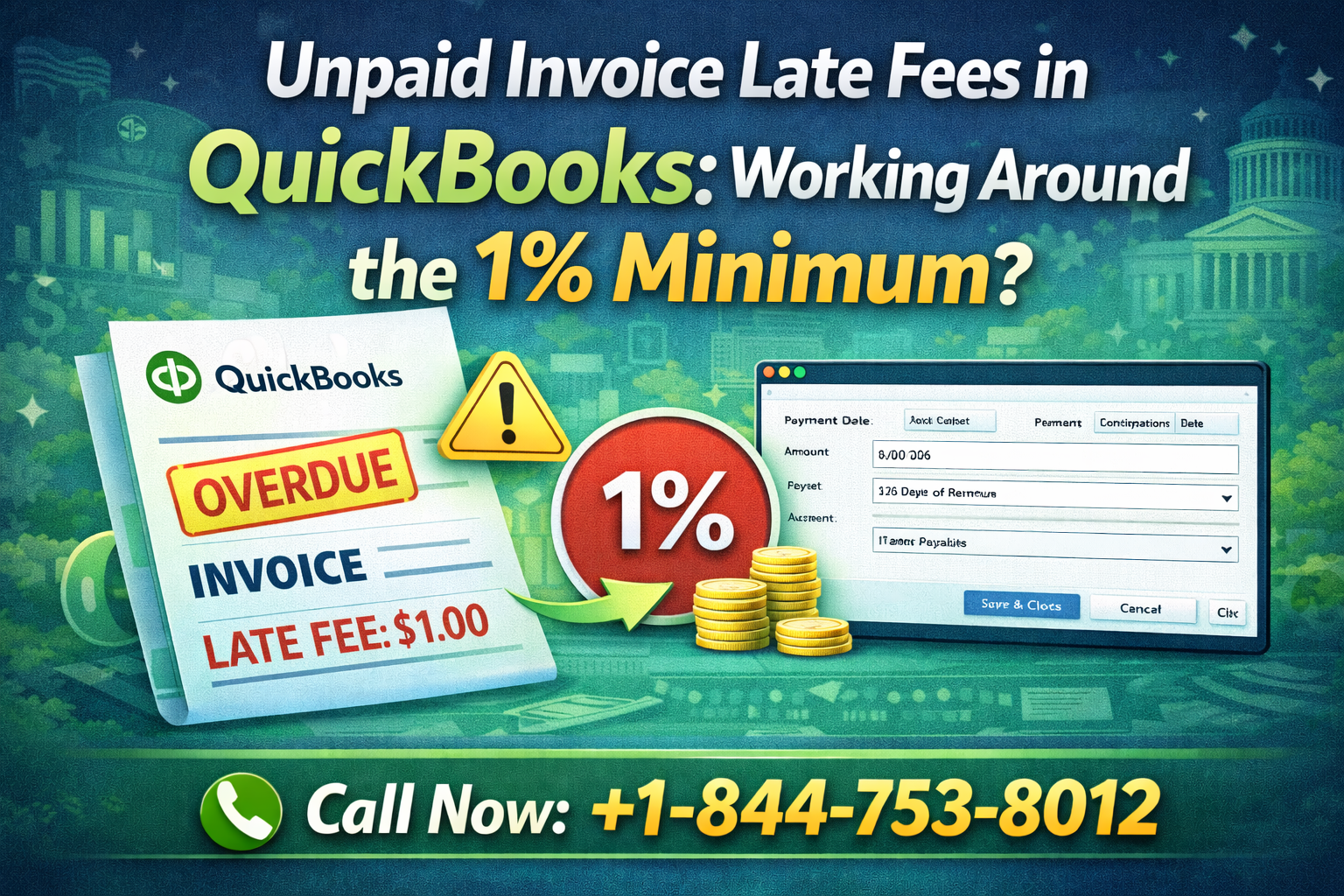
For many businesses, late payments are an unfortunate reality. QuickBooks provides tools to apply automatic late fees, helping encourage timely payments. However, some users encounter a frustrating limitation: the QuickBooks minimum late fee is set at 1%, which can feel too high for small invoices.
If you’ve ever wondered how to calculate monthly late fees from an annual rate, or how to handle the QuickBooks automatic late charge workaround, this guide has you covered. We’ll explore QuickBooks unpaid invoice late fee options, APY late fee QuickBooks vs monthly, and strategies for working around the 1% minimum.
Understanding QuickBooks Automatic Late Fees
QuickBooks allows you to automatically apply late fees to unpaid invoices. These fees help:
- Compensate for delayed payments
- Encourage customers to pay on time
- Maintain consistent cash flow
You can customize QuickBooks late fee settings, choosing between:
- Percentage-based fees (minimum 1%)
- Flat fees
- One-time or recurring monthly fees
However, many users face restrictions when trying to apply fees less than 1%, prompting the need for creative workarounds.
Also Read: How Long Does SSA Take to Process W-2/W-3 Filed Through QuickBooks Payroll?
QuickBooks Late Fee Settings Overview
Setting Up Late Fees in QuickBooks Desktop or Online:
- Go to Edit → Preferences → Sales & Customers → Company Preferences.
- Click Set Up Late Fees or Terms & Conditions.
- Choose between:
- Percentage of invoice (e.g., 1%)
- Flat amount (fixed dollar fee)
- Decide when to charge the fee (e.g., after 15 or 30 days overdue).
Note: QuickBooks enforces a minimum 1% late fee, which can be challenging for small invoices.
This is where many businesses look for the QuickBooks automatic late charge workaround.
The 1% Minimum Challenge
QuickBooks restricts unpaid invoice late fees to a minimum of 1% of the invoice total. For example:
- A $50 invoice with a 1% fee = $0.50 minimum
- QuickBooks will not allow 0.5% or lower
This limitation can be frustrating if your goal is to apply a smaller monthly late fee percentage QuickBooks, or if you want to charge 9 percent annual late fee QuickBooks divided monthly.
APY Late Fee vs Monthly Late Fee in QuickBooks
Many accountants and business owners calculate late fees based on annual percentage yield (APY) rather than monthly fees. Understanding the difference is key:
- APY late fee QuickBooks: Annualized rate, often 9% or more
- Monthly late fee: The corresponding monthly rate based on APY
Example:
- Annual late fee: 9%
- Divide by 12 months → Monthly late fee = 0.75%
Here’s the catch: QuickBooks cannot enter less than 1 percent late fee QuickBooks, so 0.75% monthly is below the minimum.
This is a common issue for businesses trying to align invoice late charge QuickBooks with legal or contractual limits.
Also Read: How to Record a Payment Made on a Government Website in QuickBooks Desktop
QuickBooks Automatic Late Charge Workaround
If you need to apply less than 1% late fees, there are several workarounds:
1. Use Flat Amount Fees Instead of Percentage
- Calculate the desired monthly fee manually
- Apply it as a flat fee in QuickBooks
- Avoid the 1% minimum limitation
For example:
- $100 invoice, target 0.75% = $0.75
- Set flat fee = $1 (closest allowed)
2. Apply Fees Outside QuickBooks, Then Adjust
- Track smaller late fees manually in a spreadsheet
- Apply total monthly fees when they reach a dollar threshold
- Record the fee as a miscellaneous charge or service item
3. Adjust Invoice Terms Strategically
- Extend due dates slightly
- Apply 1% minimum to larger invoices only
- Combine smaller fees into a single charge each quarter
These strategies allow you to enforce late fees while complying with QuickBooks’ system constraints.
How to Calculate Monthly Late Fee From Annual Rate
For businesses charging an annual rate like 9 percent annual late fee QuickBooks, the monthly calculation is straightforward:
Monthly Fee (%) = Annual Fee (%) ÷ 12
- Example: 9% ÷ 12 = 0.75% per month
- If the fee is below QuickBooks’ 1% minimum, use a flat fee workaround
This method ensures your QuickBooks late fee APY vs monthly calculations are accurate, even if the software won’t let you enter sub-1% percentages.
Posting Late Fees in QuickBooks
Once calculated, you can post the late fee:
- Open the invoice in QuickBooks
- Click Apply Credits or Add Charge
- Enter the fee as:
- Percentage (if above 1%)
- Flat Fee (recommended workaround)
- Add memo for clarity (“Late fee for overdue invoice”)
- Save and send updated invoice
This ensures your books reflect QuickBooks unpaid invoice late fee activity for accurate reporting and reconciliation.
Also Read: How Long Does SSA Take to Process W-2/W-3 Filed Through QuickBooks Payroll?
QuickBooks Minimum Late Fee Considerations
The QuickBooks minimum late fee is designed to prevent trivial entries and rounding errors. However, for smaller invoices, this may:
- Overcharge customers slightly
- Cause friction in client relationships
- Distort monthly APY calculations
Workarounds (flat fees, quarterly aggregation) help mitigate these challenges.
Tips for Managing Late Fees Effectively
- Communicate Early: Clearly state late fees in your invoice terms.
- Automate Where Possible: Use QuickBooks automatic late fees to reduce manual tracking.
- Consider Customer Relationships: Apply fees fairly, especially for small invoices.
- Use Flat Fees Strategically: Combine multiple small late fees into one larger, permissible charge.
- Track Separately for Reporting: Keep a separate account for late fees to monitor their impact on revenue.
Why Late Fees Matter for Your Business
Late fees serve multiple purposes:
- Incentivize timely payments
- Offset costs of delayed cash flow
- Encourage consistent accounting practices
- Align with legal and contractual obligations
Even with QuickBooks’ 1% minimum limitation, applying fees strategically ensures your business is protected.
Get Expert Help
If you’re struggling with QuickBooks unpaid invoice late fee settings, APY vs monthly calculations, or QuickBooks automatic late charge workaround, expert guidance can save time and prevent mistakes.
Call 844-753-8012 for assistance with QuickBooks late fee settings, invoice late charges, and automatic fee workarounds.
Final Thoughts
QuickBooks makes it easy to apply late fees to unpaid invoices, but the 1% minimum late fee QuickBooks can be restrictive for small invoices. By understanding:
- APY vs monthly rates
- Flat fee workarounds
- Manual posting strategies
You can enforce fair late charges without overcomplicating your accounting.
With clear policies, careful calculations, and strategic use of QuickBooks tools, managing unpaid invoice late fees becomes straightforward and compliant.
For immediate help with QuickBooks late fee settings and workarounds, call 844-753-8012 today.
Common Questions About QuickBooks Late Fees
A: Not directly. Use flat fees or combined charges to approximate smaller percentages.
A: Divide 9% by 12 → 0.75% monthly. Apply as a flat fee if below 1%.
A: APY is annualized, reflecting the full year. Monthly is simply the fraction of APY applied each month.
A: Not if the percentage is under 1%. Use the automatic late charge workaround with flat fees.