
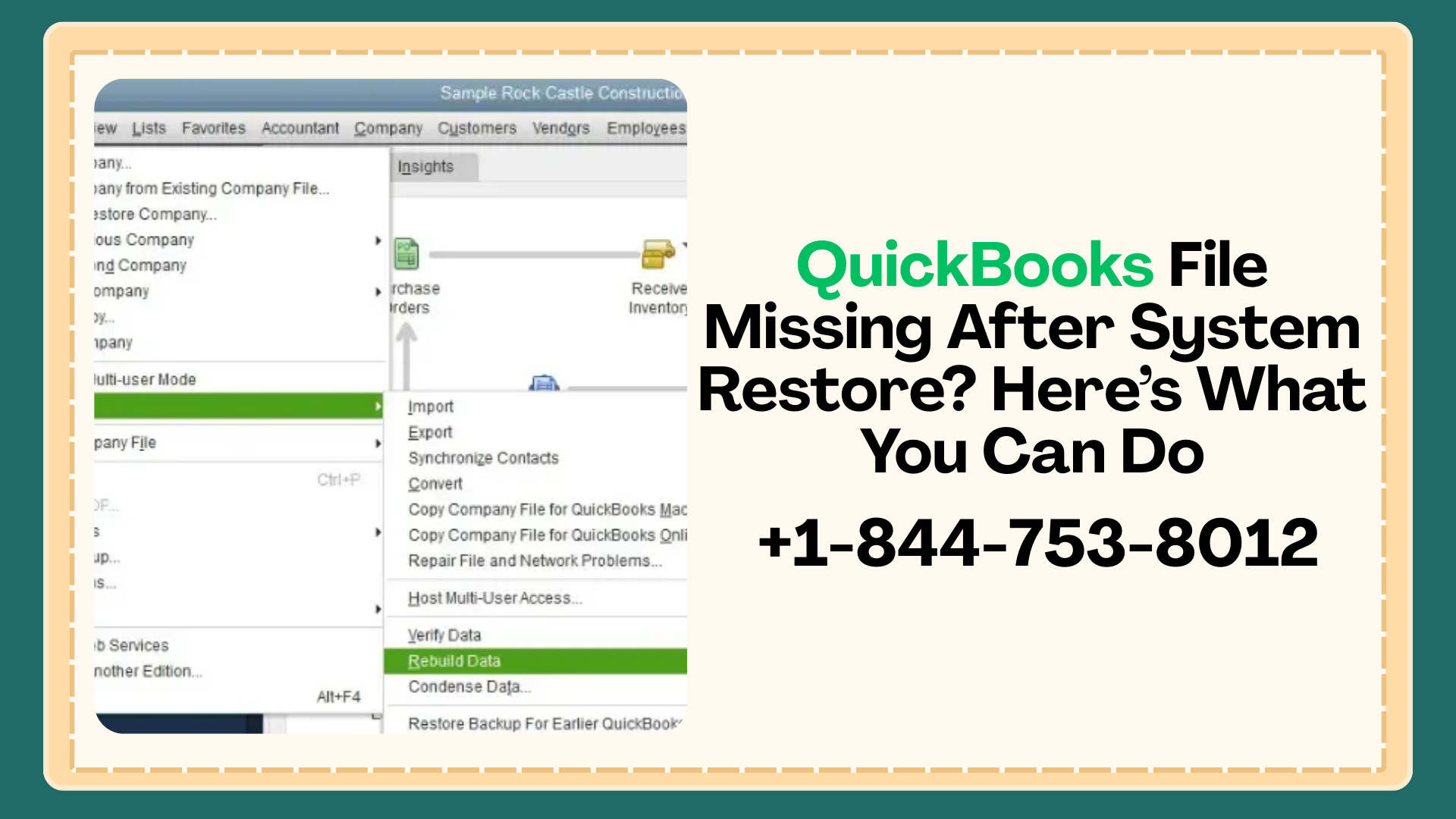
Discovering that your QuickBooks company file is missing after a system restore can be extremely stressful, especially if you were using a new laptop as your server PC. You thought the restore wouldn’t delete anything, but now the folder appears unavailable, and your QuickBooks Desktop work seems lost.
If this sounds familiar, don’t panic. In this guide, we’ll explain why your file may be missing, what steps you can take to recover it, and how to prevent this from happening in the future. For urgent assistance, you can reach QuickBooks Support at 844-753-8012.
Why Your QuickBooks File Might Be Missing After a System Restore
A system restore is designed to roll back your computer settings to a previous state without affecting personal files. However, certain scenarios can cause QuickBooks files to appear missing:- Restore affected file paths – If your QuickBooks file was saved in a location that the restore altered, the system may mark the folder as unavailable.
- Temporary file corruption – System restore can sometimes interfere with temporary files QuickBooks uses, preventing access.
- QuickBooks Server Issues – If the laptop was being used as a server PC, network paths may be disrupted after the restore.
- File deletion – Rarely, if the QuickBooks folder was in a synced location (OneDrive, Google Drive, network drive), it could be removed during the restore.
Also Read: QuickBooks Tool Hub Issue: How to Troubleshoot and Fix Common Problems
Steps to Recover a Missing QuickBooks Company File
Step 1: Search Your Computer for the File
- Press Windows + S and type
*.QBW(QuickBooks company file extension). - Check C:\Users\YourUserName\Documents\QuickBooks or any custom folder where you saved your file.
- If you see the file, copy it to a safe location before opening.
Step 2: Check the Recycle Bin
Sometimes files are moved to the Recycle Bin during restores or updates.- Open the Recycle Bin and look for
.QBWfiles. - If found, right-click → Restore.
Step 3: Check for Backups
If you have been performing QuickBooks backups, now is the time to restore:- Open QuickBooks Desktop
- Go to File → Open or Restore Company → Restore a Backup Copy → Local Backup
- Navigate to your backup folder and select the latest
.QBBfile - Follow the prompts to restore
Step 4: Use the QuickBooks Auto Data Recovery Feature
QuickBooks Desktop includes Auto Data Recovery (ADR) to recover lost data.- Ensure your QuickBooks version supports ADR (2012 and later).
- Navigate to the folder containing your
.QBWfile and look for.QBW.TLGand.QBW.NDfiles. - Follow Intuit’s ADR recovery steps to rebuild your company file.
Step 5: Check Network or Cloud Locations
If your QuickBooks file was stored on:- A network drive (NAS)
- Cloud services like OneDrive, Google Drive, or Dropbox
Step 6: Avoid Using the Problem Laptop Until Recovery
Since you mentioned the fan issue, it’s possible the hardware is overheating. Continuing to use the laptop may risk further data loss. Consider:- Shutting down the laptop and connecting the drive to another computer
- Attempting file recovery or backup restoration there
Step 7: Contact QuickBooks Support
If you cannot locate your file or restore it safely, call QuickBooks Support at 844-753-8012. Support agents can:- Guide you step-by-step through ADR recovery
- Help locate files in hidden or corrupted folders
- Assist with network and server PC QuickBooks setup
Preventing Future QuickBooks File Loss
- Regular Backups – Always create backups of QuickBooks files before system changes.
- Cloud Storage – Store company files on secure cloud drives for recovery.
- Separate Server PCs – Avoid using laptops as permanent QuickBooks servers.
- System Restore Awareness – Know which folders may be affected before performing a restore.
- QuickBooks Auto Data Recovery – Keep this feature enabled in QuickBooks Desktop.
QuickTips for IT Newbies
If you’re not an IT expert:- Don’t panic – files are rarely permanently gone.
- Avoid installing new software on the affected laptop until recovery is complete.
- Take screenshots or notes about file paths, folders, and error messages for support.
Conclusion
Losing a QuickBooks company file after a system restore is stressful, especially on a new laptop with hardware issues. However, with careful file searching, backup restoration, or using QuickBooks Auto Data Recovery, your file can often be recovered safely. Always remember: backup first, restore later, and avoid using problematic hardware until the file is secure. For immediate professional assistance, reach QuickBooks Support at 844-753-8012.Frequently Asked Questions
Q1: Can a system restore delete QuickBooks files?
System restore typically doesn’t delete personal files, but files stored in system or synced folders may become unavailable.
Q2: How can I find my QuickBooks company file if it says “unavailable”?
Search your PC using *.QBW, check the Recycle Bin, backups, and network/cloud locations.
Q3: What is QuickBooks Auto Data Recovery?
ADR is a feature that allows you to restore lost company files using transaction log files (.TLG) and backup (.QBW) files.
Q4: Should I continue using the laptop if the fan is always on?
No. Overheating hardware can risk further data loss. Seek professional help or use another computer to recover files.
Q5: Who can help me recover my QuickBooks file safely?
Call QuickBooks Support at 844-753-8012 for step-by-step recovery assistance.